Learning from the city: challenges and opportunities in higher education in architecture and urban design to promote a more sustainable urban development in the Monterrey metropolitan zone
DOI:
https://doi.org/10.29105/contexto20.31-542Keywords:
sustainable urban development, service-learning, higher educationAbstract
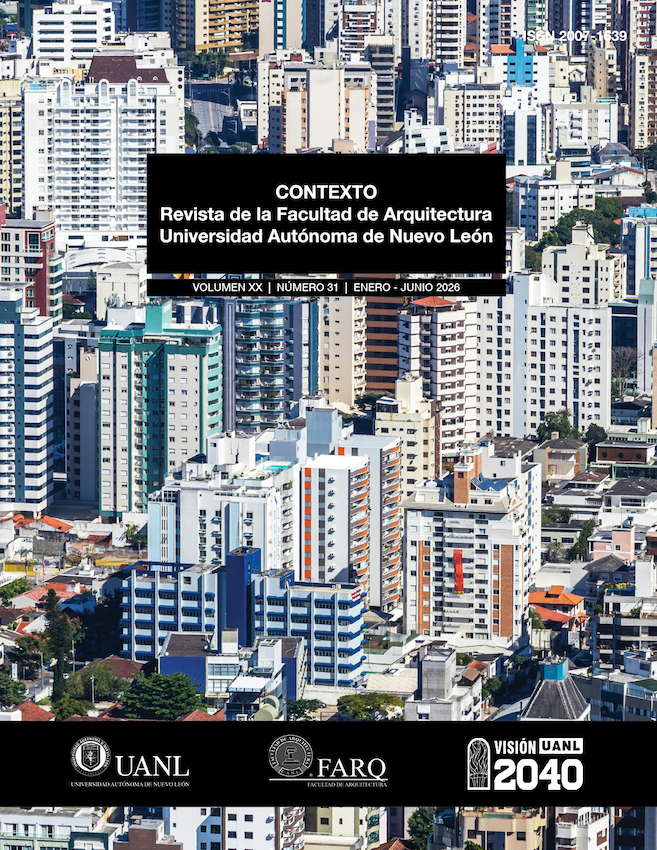
This article presents a proactive vision for the sustainable development of the contemporary city, based on the main challenges and opportunities observed in the Monterrey Metropolitan Area (MMA) in Mexico. The MMA, the second-largest city in the country and an important industrial and economic hub, faces significant urban challenges due to its accelerated growth, including mobility issues, lack of quality public spaces, and pollution, among others.
These challenges reflect common trends in many cities globally. Therefore, the article proposes a reflection on the opportunities to promote more sustainable urban development in the contemporary city, through university education in architecture and urban design, with a focus on social responsibility.
This proposal is based on academic and community service projects that allow students to learn, through critical observation of their environment, about the challenges and opportunities of urban spaces. By considering the city as an educational space beyond the classroom and highlighting innovative methodologies such as service-learning, future professionals are presented as agents of change and creators of social well-being, who can contribute to a more sustainable urban future.
Downloads
References
Acilu, A., & Larripa, A. (2020). Camp_us: co-diseñando universidad y ciudad. Pamplona, 2020. Jornadas sobre Innovación Docente en Arquitectura. https://doi.org/10.5821/jida.2020.9439 DOI: https://doi.org/10.5821/jida.2020.9439
Aparicio Moreno, C., et al. (2011). La segregación socio-espacial en Monterrey a lo largo de su proceso de metropolización. Región y Sociedad, 23(52). El Colegio de Sonora. DOI: https://doi.org/10.22198/rys.2011.52.a185
Campos Venuti, G. (1983). Città, metropoli, tecnologie, politiche, pianificazione territoriale. Franco Angeli.
Carrasco Bonet, Marta; Fava, Nadia. (2021) Urbanismo participativo: una herramienta docente para tiempos de incertidumbre. Jornadas sobre Innovación Docente en Arquitectura. https://doi.org/10.5821/jida.2021.10591 DOI: https://doi.org/10.5821/jida.2021.10591
Ciudades Educadoras. (1990). Carta de Ciudades Educadoras: Declaración de Barcelona. https://www.edcities.org/carta-de-ciudades-educadoras/
Combrinck, C., & Nortjé, T. L. (2021). Activating the edge: the university campus as anchor institution. Development Southern Africa, 38(3), 353–370. https://doi.org/10.1080/0376835X.2020.1760083 DOI: https://doi.org/10.1080/0376835X.2020.1760083
Dewey, J. (1950). Las escuelas del mañana. Losada.
Díaz-García, V. y LopezDeAsiain, M. (2022). Aprendizaje-servicio en la docencia de la arquitectura: presupuestos participativos y los Objetivos de Desarrollo Sostenible. ACE: Architecture, City and Environment, 16(48), 10528. http://dx.doi.org/10.5821/ace.16.48.10528 DOI: https://doi.org/10.5821/ace.16.48.10528
Elliot, J. (1990). La investigación-acción en educación. Morata.
Escobar-Pérez, J., & Cuervo-Martínez, A. (2008). Validez de contenido y juicio de expertos: Una aproximación a su utilización. Avances en Medición, 6, 27–36.
García Cervantes N, Hinojosa Hinojosa K (2023), "Opportunities and challenges for service-learning experiences in informal urban settlements". Archnet-IJAR: International Journal of Architectural Research, Vol. 17 No. 2 pp. 358–374, https://doi.org/10.1108/ARCH-12-2021-0348 DOI: https://doi.org/10.1108/ARCH-12-2021-0348
García Escamilla, J. O. (2018). Movilidad cotidiana: Aproximación al uso del territorio y el tiempo a partir de la periferia urbana en dos casos de estudio internacionales de México y Estados Unidos. Planur-e: Territorio, urbanismo, paisaje, sostenibilidad y diseño urbano, 11, 9.
Gehl, J. (2014). Ciudades para la gente. ONU-Habitat, Ediciones Infinito.
Gobierno del Estado de Nuevo León. (2010). Programa de Acción ante el Cambio Climático para el Estado de Nuevo León 2010-2015. https://aire.nl.gob.mx
Gómez, D. T., Sánchez-Guevara, C., Heredia, M. G., Núñez-Peiró, M., Ludueña, C. A., Barrera, M. D. M. B., . & Lezcano, R. G. (2025). Training Future Architects toward Energy Poverty Challenges. In Teaching Design for Sustainable Futures (pp. 60-78). Routledge. https://doi.org/10.4324/9781003495444-7 DOI: https://doi.org/10.4324/9781003495444-7
Graell Martín, M. (2022). University professional and citizenship education through service learning. International Journal of Intellectual Property Management, 12(1), 148–163. https://doi.org/10.1504/IJIPM.2022.120994 DOI: https://doi.org/10.1504/IJIPM.2022.120994
Herrero, M. A. (2002). El “problema del agua”. Un desafío para incorporar nuevas herramientas pedagógicas al aula universitaria (Tesis de especialidad en docencia universitaria). Facultad de Ciencias Veterinarias, Universidad de Buenos Aires.
INEGI. (2020). Censo de Población y Vivienda 2020. https://www.inegi.org.mx/programas/ccpv/2020/
INRIX. (2023). INRIX 2022 Global Traffic Scorecard: London tops list as most congested city, U.S. cities inch closer. https://inrix.com/press-releases/2022-global-traffic-scorecard-uk/
Jacoby, B. (1996). Service-learning in today’s higher education. In B. Jacoby et al. (Eds.), Service-learning in higher education: Concepts and practices (pp. 3–25). Jossey-Bass.
Kemmis, S., & McTaggart, R. (1988). Cómo planificar la investigación-acción. Alertes.
Knapp, T. D., & Bradley, J. F. (2010). The effectiveness of service-learning: It’s not always what you think. Journal of Experiential Education, 33(3), 208–224. https://doi.org/10.1177/105382591003300302 DOI: https://doi.org/10.5193/JEE33.3.208
Luna-Gijón, G., Nava Cuahutle, A.A., & Martínez-Cantero, D. A. (2022). El diario de campo como herramienta formativa durante el proceso de aprendizaje en el diseño de información. Zincografía, 6(11). https://doi.org/10.32870/zcr.v6i11.131 DOI: https://doi.org/10.32870/zcr.v6i11.131
Martín-García, X., Bär-Kwast, B., Gijón-Casares, M., Puig-Rovira, J. M., & Rubio-Serrano, L. (2021). El mapa de los valores del aprendizaje-servicio. Revista de Educación, 16(1), 12–22. https://doi.org/10.17163/alt.v16n1.2021.01 DOI: https://doi.org/10.17163/alt.v16n1.2021.01
Mayor Paredes, D. (2018). Aprendizaje-servicio: Una práctica educativa innovadora que promueve el desarrollo de competencias del estudiantado universitario. Actualidades Investigativas en Educación, 18(3), 494–516. https://doi.org/10.15517/aie.v18i3.34418 DOI: https://doi.org/10.15517/aie.v18i3.34418
Montemayor Fernández, H. A., & Montemayor Bosque, J. H. (2021). Propuesta sobre la mejora de la imagen urbana, caso Monterrey. Revista Cuadernos de Arquitectura y Asuntos Urbanos, 11.
Naciones Unidas. (2018). Las ciudades seguirán creciendo, sobre todo en los países en desarrollo. Naciones Unidas. https://www.un.org/es/desa/2018-world-urbanization-prospects
Naciones Unidas. (2022) Sustainable cities and human settlements. Sustainable Development Knowledge Platform. https://sustainabledevelopment.un.org/topics/sustainablecities.
Navarrete Peñuela, M. (2017). Desarrollo urbano sustentable: el gran desafío para América Latina y los preparativos para hábitat III. Luna Azul, (45), 123–149. https://doi.org/10.17151/luaz.2017.45.8 DOI: https://doi.org/10.17151/luaz.2017.45.8
Page, M. J., McKenzie, J. E., Bossuyt, P. M., Boutron, I., Hoffmann, T. C., Mulrow, C. D., et al. (2022). Declaración PRISMA 2020: Una guía actualizada para la publicación de revisiones sistemáticas. Revista Panamericana de Salud Pública, 46, e112. https://doi.org/10.26633/RPSP.2022.112 DOI: https://doi.org/10.26633/RPSP.2022.112
Palos, J. (2010). ¿Por qué hacer actividades de Aprendizaje-Servicio? En J. M. Puig (Coord.), Aprendizaje-Servicio (ApS). Educación y compromiso cívico (pp. 151–161). Graó.
Plan Educativo Nacional. (2009). Universidad Nacional Autónoma de México. https://www.planeducativonacional.unam.mx/CAP_00/Text/00_05a.html
Puig-Rovira, J. M., Batlle, R., Bosch, C., & Palos, J. (2007). Aprendizaje-servicio: Educar para la ciudadanía. Octaedro.
Puig-Rovira, J. M., Casares, M. G., Martín, X., & Serrano, L. R. (2011). Aprendizaje-servicio y educación para la ciudadanía. Revista de Educación, (1), 45–67.
Puig-Rovira, J. M. (2012). Compromís cívic i aprenentatge a la universitat: Experiències de l’aprenentatge servei. Graó.
Puig-Rovira, J. M. (2021). Pedagogía de la acción común (Vol. 55). Graó.
Rubio, L., & Escofet, A. (Eds.). (2018). Aprendizaje-servicio (ApS): Claves para su desarrollo en la universidad. Ediciones Octaedro.
Tapia, M. N. (2007). Aprendizaje-servicio en la educación superior: Un panorama introductorio. Centro Latinoamericano de Aprendizaje y Servicio Solidario. http://www.centroetica.uct.cl/documentos/archivos/1.2,1
Universidad Autónoma de Nuevo León (UANL). (2022). Secretaría de Sustentabilidad. https://www.uanl.mx/dependencias/secretaria-de-sustentabilidad/
Varela, T.V., & Sutton, L. H. (2021). La codificación y categorización en la teoría fundamentada, un método para el análisis de los datos cualitativos. Investigación en Educación Médica, https://doi.org/10.22201/fm.20075057e.2021.40.21367 DOI: https://doi.org/10.22201/fm.20075057e.2021.40.21367
Vittadini, M. R. (1991). La città accessibile. En L. Balbo (Ed.), Tempo di vita. Studi e proposte per cambiarli (pp. [coloca páginas si están disponibles]). Feltrinelli.
Downloads
Published
How to Cite
Issue
Section
License
Copyright (c) 2026 Jorge Omar García Escamilla, Mariona Graell Martín

This work is licensed under a Creative Commons Attribution-NonCommercial 4.0 International License.
The authors who publish in this journal accept the following conditions:
1. The authors keep the copyright and give the journal the right of the first publication, with their content registered under the Creative Commons License, which lets third parties to use the published material as long as they mention the authors and the first publication from the journal.
2. The authors can make other independent and additional contractual agreements for the non-exclusive distribution of the version of the article published in the journal (for example an institutional repository or a book) provided that they explicitly mention that the content was first published in CONTEXTO. Revista de la Facultad de Arquitectura de la Universidad Autónoma de Nuevo León..

















.png)